
By Beautiful Machine Magazine Staff
A business can take years to build and only minutes to damage.
Social media has given consumers an incredible voice. When businesses provide poor service, sell defective products, or treat customers unfairly, people deserve to know. Honest reviews help consumers make better decisions and encourage businesses to improve.
The problem begins when opinions replace facts.
Too many people now believe that because they have a social media account, they have the right to publicly damage someone’s reputation over a misunderstanding or a personal preference. Instead of asking questions or giving a business an opportunity to fix a problem, they immediately post accusations that can follow a business for years.
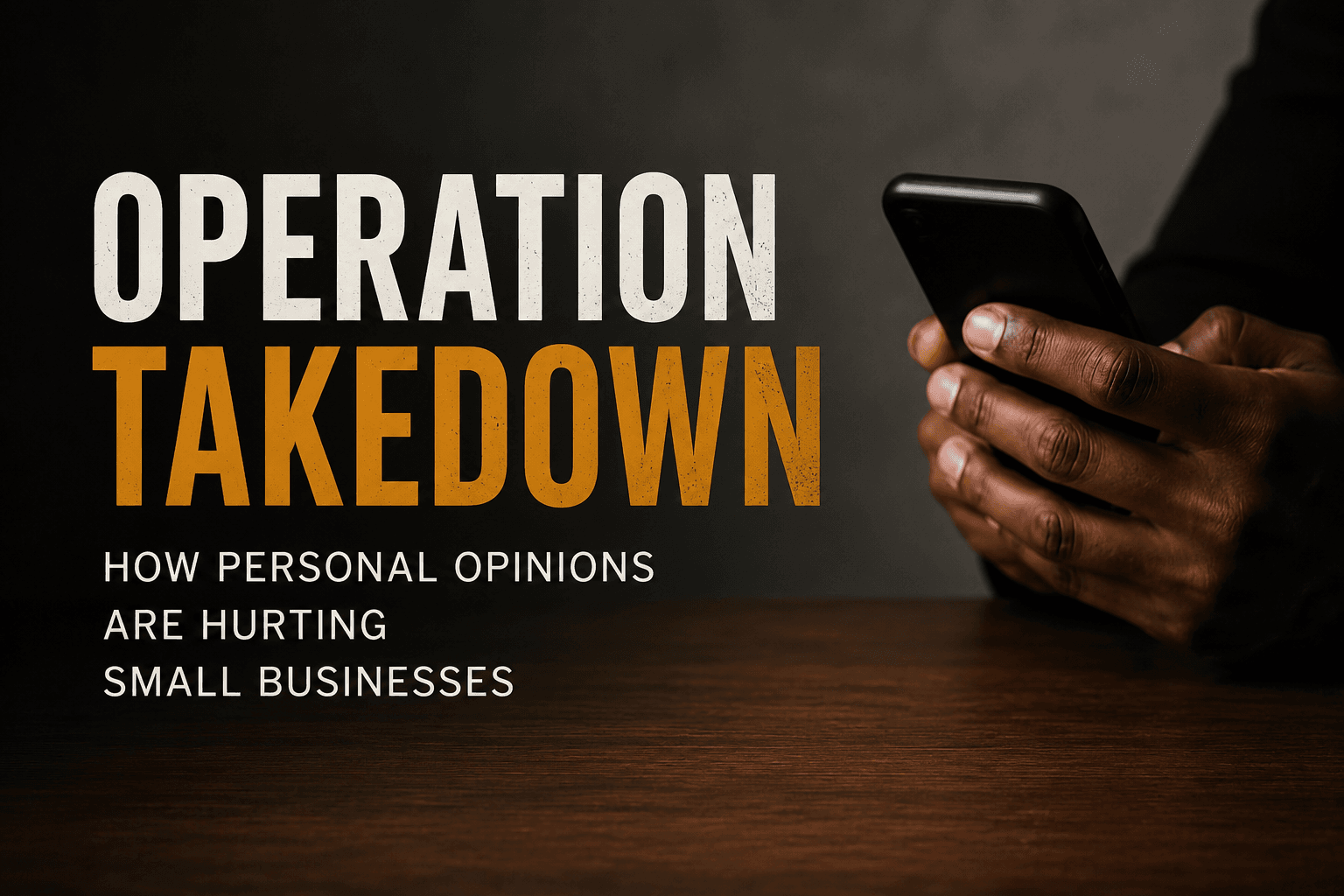
We call it Operation Takedown.
One local restaurant owner learned this lesson the hard way. He served a traditional whole fish entrée exactly as described on the menu with the head still attached. That is how the dish is prepared in many cultures. Some customers never read the description. When the meal arrived, they were upset because they were surprised to see the fish exactly as it had been advertised. Some demanded refunds. Others left negative online reviews even though the restaurant had done nothing wrong.
Eventually, the owner removed one of his signature dishes because defending himself against misunderstandings became too expensive. A customer failed to read the menu, yet the business paid the price.
Another entrepreneur created a singles event that required applicants to answer questions about their lifestyle, values, and financial stability. His goal was simple. He wanted to create meaningful connections between people with similar backgrounds and expectations. He also charged an admission fee that covered the cost of the venue, food, beverages, entertainment, and staffing. It also ensured that people attending were serious about finding a relationship.
One woman looked at the price and immediately called him a scam artist online.
She was never cheated.
She never attended the event.
She simply disagreed with the price.
There is a world of difference between saying, “That event is not for me,” and accusing someone of being dishonest. One is an opinion. The other can damage a reputation that took years to build.
Beautiful Machine Magazine experienced something very similar this summer.
For more than five years, we have hosted successful events throughout Metro Detroit. Most of them have been free because of the generous support of our sponsors and partners. This year, our summer kickoff event required a modest fifty dollar admission fee to help cover production expenses.
The turnout exceeded expectations.
Guests arrived early, and the venue temporarily slowed entry because of capacity concerns. Once communication improved between our team and the venue, most of the people waiting were admitted after a short delay. Anyone who asked for a refund received one immediately.
We believed the issue had been resolved.
Instead, a longtime guest who had attended our events for years went online and accused Beautiful Machine of scamming people.
That accusation ignored years of free community events, years of goodwill, and the fact that refunds were given without hesitation. There was no scam. There was simply an unexpected situation that was handled fairly and professionally.
One honest conversation could have cleared everything up.
Instead, social media became the place where facts no longer mattered.
Unfortunately, this happens every day.
Someone gives a restaurant a bad review because the food did not taste like what they expected.
Someone criticizes a business because they do not like the pricing.
Someone labels an entrepreneur dishonest because they do not understand the business model.
Personal preference is not the same as truth.
Not liking something does not make it bad.
Not understanding something does not make it dishonest.
Disagreeing with a price does not make it a scam.
This conversation is especially important in the African American community. Black owned businesses often succeed despite limited access to capital and countless obstacles. Every unfair review and every false accusation has the potential to hurt not only the owner but also employees, families, and the surrounding community.
None of this means businesses should be protected from legitimate criticism. If a company lies, serves unsafe food, or consistently provides poor service, customers absolutely have the right to speak up.
But there is a difference between exposing wrongdoing and creating it.
Before writing that review, ask yourself a few simple questions.
Did I understand what I was buying?
Did I read the description?
Did I give the business an opportunity to fix the problem?
Am I sharing facts or simply expressing my opinion?
Strong communities are built by supporting honest businesses while holding bad businesses accountable. They are not built by destroying hardworking entrepreneurs over misunderstandings or personal preferences.
Behind every small business is someone who invested their savings, works long hours, and dreams of building something that will serve their community.
If we truly want stronger communities and stronger Black businesses, we have to stop Operation Takedown.
We have to choose fairness.
We have to choose accountability.
Most of all, we have to choose the truth.

