
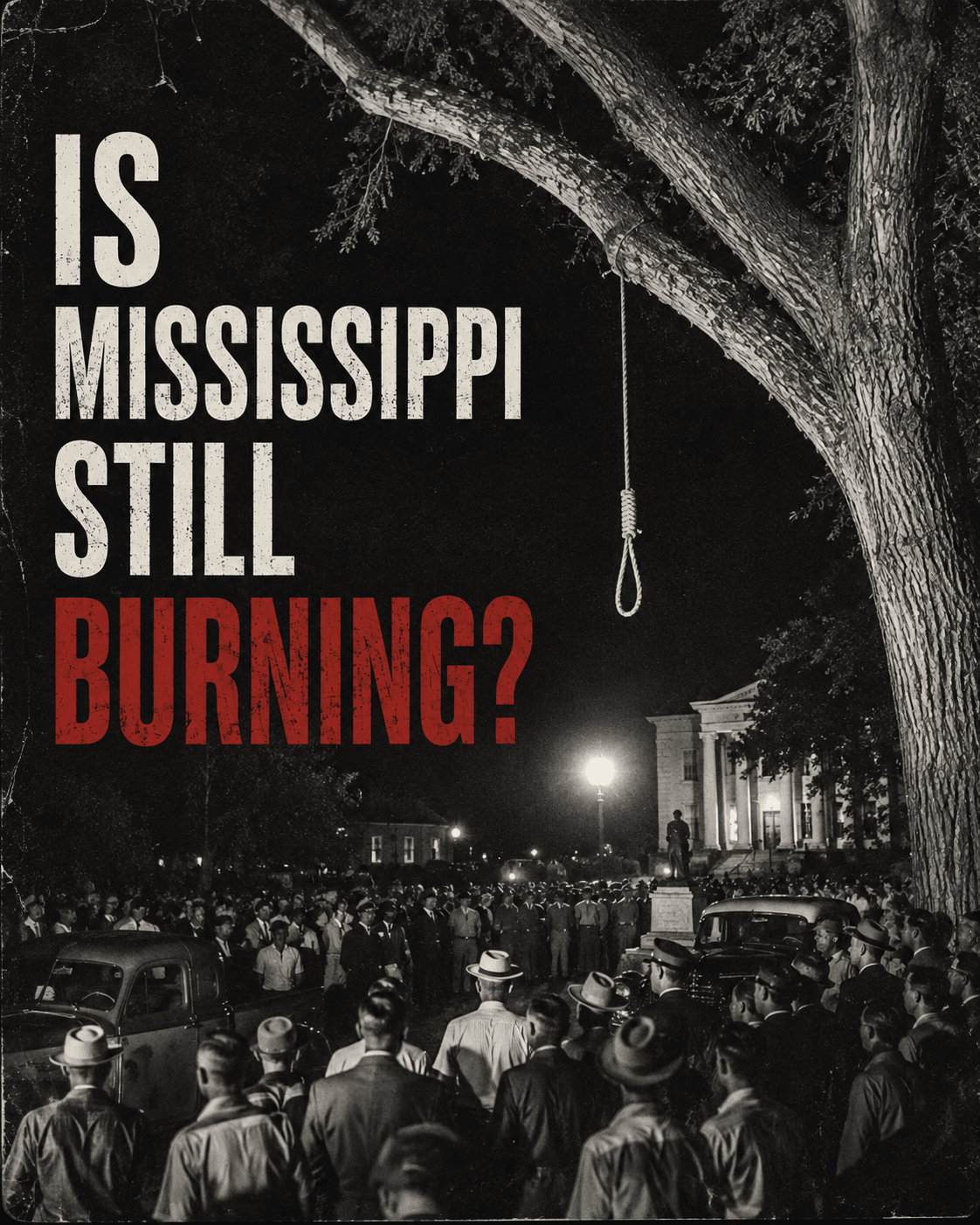
Suspicious deaths, missing Black Americans, questions about law enforcement transparency and the painful history that makes it impossible for some families to simply accept that there is nothing to see.
By Beautiful Machine Magazine
There are some images that America cannot separate from its history, and few are more disturbing than the image of a Black person hanging from a tree. In Mississippi, that image carries an even deeper meaning because this is a state where lynching, racial terror and the murder of civil rights workers are not distant pieces of folklore. They are documented American history.
That history is one reason several recent deaths involving young Black people in Mississippi have generated fear, anger and suspicion. It does not mean those deaths were lynchings, and it does not mean that every official finding should automatically be questioned. It does mean that authorities investigating unusual deaths in Mississippi should understand that transparency is not an inconvenience. In cases like these, transparency is essential to public trust.
The questions became even louder on August 3, 2026, when 29 year old Tasia Fortune, a Black mother of four, was found hanging outside an abandoned house in Jackson, Mississippi. Fortune had been missing, and her mother, Christy Spivey, has publicly said that she does not believe her daughter took her own life. Jackson City Councilman Kenneth Stokes has called for federal assistance.
There is an important fact that must remain at the center of any responsible discussion about Fortune’s death. Authorities have not determined that she committed suicide, and they have not determined that she was murdered. As of the latest credible reporting, the circumstances remain under investigation and her body was sent to the Mississippi State Medical Examiner’s Office for an autopsy.
That uncertainty should not be filled with rumors. It should lead to a careful investigation that gives Fortune’s family and the public confidence that every reasonable possibility was examined.
THE IMAGE THAT MISSISSIPPI CANNOT ESCAPE
Fortune’s death follows another case that generated national attention. In 2025, 21 year old Demartravion “Trey” Reed, a Black student at Delta State University, was found hanging from a tree on campus.
Almost immediately, social media filled with claims that Reed had been beaten and that bones in his body had been broken. Official examinations did not support those claims. Authorities reported no injuries consistent with an assault, and the Mississippi State Medical Examiner determined that Reed died by suicide.
Those facts matter because suspicion should never be presented as evidence. A Black person found hanging from a tree has not necessarily been lynched, regardless of how disturbing the image may be. At the same time, it would be unrealistic to expect Black Americans, particularly Black Mississippians, to look at that image without remembering what happened in the same state generations earlier.
WHY THE WORDS “MISSISSIPPI BURNING” STILL MATTER
In June 1964, civil rights workers James Chaney, Andrew Goodman and Michael Schwerner disappeared near Philadelphia, Mississippi. They had been investigating the burning of a Black church and working to register Black voters.
The three men were murdered, and the FBI investigation became known as MIBURN, an abbreviation for Mississippi Burning. Their disappearance became one of the defining cases of the civil rights era and exposed a world in which racial violence could intersect with people connected to local authority.
That history does not prove anything about a death occurring in Mississippi today. It does explain why trust cannot simply be demanded from communities whose history taught them that official authority was not always on their side.
The lesson from Mississippi’s past should not be that every unexplained death involving a Black person is a racial murder. The lesson should be that unusual deaths deserve thorough investigations and that public confidence must be earned through facts.
THEN CAME NOLAN WELLS
The death of 18 year old Nolan Xavier Wells presents a very different set of circumstances, but it raises some of the same questions about communication, investigative thoroughness and public trust.
Wells was a college football player who traveled with friends to Horn Island off the Mississippi Gulf Coast on July 4, 2026. His friends returned to the mainland without him. Wells did not return, and his body was discovered in the water near the island two days later.
His family has questioned what happened from the beginning. One source of controversy was the early characterization of Wells’ death as an apparent accidental drowning before all of the forensic questions had been resolved. His mother has questioned how such confidence could be expressed so early in an investigation.
The circumstances surrounding Wells’ final hours also generated questions. His friends returned from Horn Island while Wells remained behind. His cellphone returned to the mainland even though he did not. His family has understandably questioned why their son would remain on an island without his phone or keys.
Accounts concerning what Wells intended to do that evening have also been disputed. His family has sought a clear timeline explaining when he was last seen, who saw him, why he remained behind and exactly how he ended up in the water.
Those questions do not prove that someone killed Nolan Wells. They demonstrate why his family wants a complete investigation and why greater transparency surrounding the evidence could help establish public confidence in whatever conclusion investigators ultimately reach.
AN AUTOPSY WITHOUT A FINAL ANSWER
The independent autopsy requested by the Wells family made the situation even more complicated. Rather than concluding that Wells had been murdered, the independent examination listed his cause and manner of death as undetermined pending further investigation. Decomposition and other limitations prevented the examination from answering every question surrounding his death.
That finding is important because an undetermined finding does not mean homicide, but it also does not mean accidental drowning. It means that the available evidence did not allow the independent examiner to make a definitive determination.
The examination did not find fractures or significant deep tissue injuries, which weighs against some of the more sensational theories that have circulated online.
The family has continued asking for additional evidence to be examined, including information contained on Nolan’s cellphone. Questions surrounding access to and examination of that phone became another point of disagreement during the investigation.
Every unresolved question creates additional space for speculation, which is precisely why transparency and clear communication from investigators are so important in a case attracting this level of public attention.
WHEN AN INVESTIGATION BECOMES A SOCIAL MEDIA TRIAL
There is another uncomfortable side of the Nolan Wells case that deserves attention. People associated with the investigation have faced harassment and threats. In August, three people were charged with threatening a judge, a witness and local officials connected with the Wells investigation.
That behavior is unacceptable, and demanding answers for Nolan Wells does not give anyone permission to threaten witnesses, officials or people who were with him before his death.
There is currently no public evidence establishing that Wells was murdered because he was Black. There is also no basis for declaring people responsible for his death simply because they were present during the trip.
A legitimate demand for transparency can quickly lose credibility when suspicion becomes accusation and accusation becomes harassment. The Wells family deserves answers, witnesses deserve safety and investigators deserve the opportunity to follow evidence without intimidation.
THE TRUST PROBLEM
Perhaps this is the real issue connecting these cases. There is a significant difference between proving that law enforcement covered something up and understanding why some Black Americans fear that something could be overlooked.
When authorities appear to reach conclusions before families believe all the evidence has been examined, suspicion grows. The same thing happens when different agencies appear uncertain about jurisdiction, when families struggle to obtain information and when important forensic questions remain unresolved.
None of those circumstances automatically proves misconduct. They demonstrate why communication matters and why law enforcement agencies should provide as much information as possible without compromising an active investigation.
Families should be able to ask whether surveillance footage was examined, whether witnesses were interviewed separately, whether cellphone evidence was preserved, whether a scene was initially treated as potentially criminal, whether forensic testing was completed and whether outside investigators reviewed the evidence.
Those are reasonable questions when someone dies under unusual circumstances. Authorities do not have to reveal evidence that could compromise an investigation, but there is a difference between protecting an investigation and appearing unwilling to explain how an investigation is being conducted.
WHAT ABOUT THE MISSING BLACK CHILDREN?
The anxiety surrounding suspicious deaths exists alongside another concern that has circulated widely in Black communities involving missing Black children and adults.
This subject requires accuracy because social media has repeatedly exaggerated legitimate missing person statistics. Not every missing person report represents a kidnapping, and many people reported missing are subsequently located.
According to the FBI’s National Crime Information Center, there were 28,551 active missing person records involving Black Americans at the end of 2024. That included 13,562 females and 14,987 males.
Those numbers include adults and children, and they should not be misrepresented as 28,551 kidnappings. Missing person records can involve runaways, family disputes, custody situations and many other circumstances.
The legitimate question is whether missing Black people receive the same urgency and public attention as other missing Americans. Some disappearances become national stories almost immediately, with television networks sending reporters and social media campaigns attracting enormous attention. Other families struggle to get attention beyond their immediate communities.
The answer is not to exaggerate the numbers. The answer is to make sure every missing child and every endangered missing person receives serious attention regardless of race.
IS RACIAL HATRED ACTUALLY INCREASING?
This is another area where facts are more useful than fear. There is no credible evidence that America is experiencing a widespread return of lynching comparable to the racial terror of the nineteenth and twentieth centuries. Overall violent crime actually declined in 2024. The FBI estimated that national violent crime decreased 4.5 percent compared with 2023, while murder and nonnegligent manslaughter declined an estimated 14.9 percent.
Hate crime presents a different picture. Law enforcement agencies reported 11,679 hate crime incidents involving 14,243 victims in 2024. Race, ethnicity and ancestry represented 53.2 percent of the motivations among victims of incidents involving a single form of bias.
The numbers involving Black Americans are particularly troubling. Among victims of hate crimes motivated by race, ethnicity or ancestry in 2024, 50.1 percent were targeted because of bias against Black or African American people.
That does not prove that the deaths of Tasia Fortune, Trey Reed or Nolan Wells were hate crimes. It proves something different. Racially motivated crime against Black Americans remains real enough that concerns about racial violence cannot simply be dismissed as paranoia.
TASIA FORTUNE STILL DESERVES AN ANSWER
The story eventually returns to Jackson and to a 29 year old mother whose family is waiting to learn how she died. Tasia Fortune was found hanging outside an abandoned house after being reported missing. Her mother does not believe she committed suicide, and a city councilman has called for federal assistance. Authorities continue investigating, and an official determination of her death has not been announced in the reporting available as this story is being published.
Beautiful Machine Magazine will not describe Fortune’s death as a lynching without evidence, and we will not describe her death as a suicide without evidence either.
The same standard should apply to Nolan Wells. His family’s questions deserve answers, but unanswered questions should not be transformed into accusations against people who have not been charged with causing his death.
The same standard should apply to Trey Reed. His death generated understandable suspicion, but the available forensic evidence supported the official determination of suicide.
Being objective does not require ignoring history. It requires refusing to decide what happened before the evidence provides an answer.
SO IS MISSISSIPPI STILL BURNING?
Maybe that question cannot be answered with a simple yes or no. Today’s Mississippi is not the Mississippi of 1964. Black Mississippians now hold political office, lead institutions, prosecute cases, investigate crimes and demand accountability in ways that were unimaginable during the darkest years of Jim Crow.
Pretending nothing has changed would be dishonest, but pretending history no longer matters would be equally dishonest.
Black Americans remain disproportionately represented among victims of racially motivated hate crime. Thousands of Black Americans remain listed as missing. Families confronting unusual deaths still sometimes feel that they must fight to receive attention, information and outside scrutiny.
The responsibility of law enforcement is not to confirm what frightened communities already believe. The responsibility is to determine what happened through evidence, careful investigation and transparency.
When evidence establishes suicide, authorities should explain why the evidence supports that conclusion. When evidence establishes an accident, authorities should explain the basis for that finding. When evidence establishes murder, investigators should find the person responsible. When racial hatred motivates a murder, authorities should identify it for exactly what it is.
Mississippi has already lived through an era when Black people disappeared, Black people were murdered and some people entrusted with enforcing the law participated in racial violence or looked the other way.
Remembering that history does not mean every unexplained death today represents another Mississippi Burning. It means Mississippi should understand better than almost anywhere in America why unanswered questions cannot simply be dismissed.
Families deserve answers based on evidence. Authorities deserve the opportunity to conduct investigations without threats or political pressure. People who have not been charged with crimes deserve protection from internet accusations. Communities deserve transparency whenever it can be provided without compromising an investigation.
Those principles should work together because that is what justice is supposed to look like. The truth does not belong exclusively to law enforcement, grieving families, activists, politicians or social media. The truth belongs to the evidence, and wherever that evidence leads, Mississippi has an obligation to follow it.
Beautiful Machine Magazine

