
By Beautiful Machine Magazine Staff
America feels different.
Turn on the television, scroll through social media, or listen to political debates, and it seems almost every issue eventually becomes about race. Conversations that once ended with disagreement now often end with anger. Friends stop speaking. Families avoid difficult discussions. People who have never met assume the worst about one another.
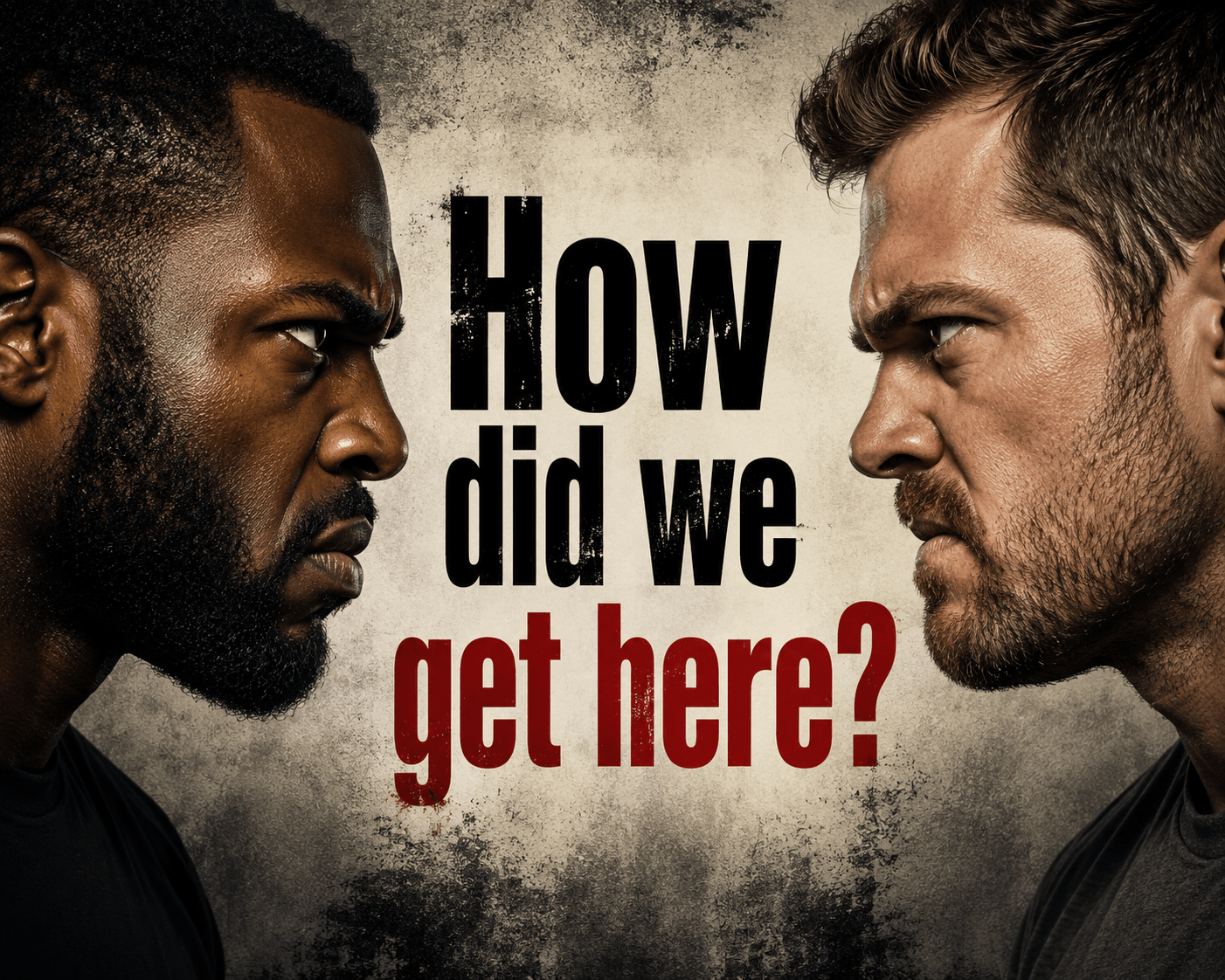
How did we get here?
To understand the present, we must first look to the past. The legacy of slavery and segregation did not disappear when the laws changed. Although the Civil Rights Act of 1964 and the Voting Rights Act of 1965 outlawed legal discrimination, their effects did not erase centuries of inequality. For example, the median wealth of White households in the United States is still nearly eight times that of Black households, according to Federal Reserve data. Redlining policies from the mid-20th century, which denied Black families access to mortgages and homeownership, continue to shape economic disparities today.
Many Black Americans still live with the long-term impact of discrimination, unequal opportunity, and harmful stereotypes. Studies have shown that Black Americans are more likely to experience disparities in education, healthcare, and criminal justice outcomes. For instance, Black Americans are incarcerated at more than five times the rate of White Americans, according to the NAACP. At the same time, many White Americans struggle to understand how events from the past continue to influence the present. Too often, these conversations begin with frustration instead of understanding, creating a disconnect that makes meaningful dialogue difficult.
This historical tension helps explain why certain moments in recent history have felt especially significant. Many people point to the election of Barack Obama as a turning point. For some Americans, his presidency represented hope and progress. For others, it marked the beginning of deeper political and racial divisions. Research from the Pew Research Center shows that partisan divides widened significantly during and after his presidency, with Democrats and Republicans increasingly viewing each other not just as political opponents, but as threats to the nation’s well-being.
As these divisions have intensified, another powerful force has shaped how we experience them: media and political influence. The rise of 24-hour news cycles and social media platforms has amplified conflict. Algorithms on platforms like Facebook and Twitter often prioritize emotionally charged content, which can increase engagement but also deepen polarization. A 2020 study from MIT found that false or misleading information spreads significantly faster on social media than factual reporting, often because it provokes stronger emotional reactions.
History has shown that fear and conflict can become effective tools for gaining attention and power. Leaders, commentators, and organizations across the political spectrum have sometimes benefited from emphasizing differences rather than common ground. Outrage attracts attention. Attention creates influence. Influence often leads to power and money.
As a result, while everyday Americans argue over race, politics, and identity, many of the people fueling those arguments continue to gain influence and wealth. This raises an important question: have we spent too much time fighting one another and not enough time asking who benefits from the fight?
Recognizing these dynamics does not mean ignoring real issues. Racism still exists. Prejudice and discrimination remain serious problems that deserve honest discussion. However, assuming that every disagreement is rooted in hatred can make productive conversations nearly impossible.
Despite the tension, there is also a shared reality that often goes overlooked. Surveys consistently show that Americans across racial and political lines prioritize similar concerns, such as economic stability, healthcare access, and education. Most Americans want the same basic things: safe neighborhoods, good schools, stable jobs, affordable housing, and opportunities for their children. These hopes are not divided by race.
So where do we go from here?
Moving forward requires a shift in how we engage with one another. We begin by listening instead of assuming. We judge people by their character and actions rather than stereotypes. We teach history honestly, acknowledging both our nation’s achievements and its failures. We demand more from leaders who profit from division, and we spend more time talking with one another than talking about one another.
America has overcome enormous challenges before because ordinary people eventually found common ground. From the Civil Rights Movement of the 1960s to the bipartisan cooperation that followed national crises like September 11, history shows that unity is possible even in times of deep division. That possibility still exists today.
Our children are watching. They will inherit the country we choose to build.
If we continue seeing one another as enemies, the divisions will only deepen. But if we choose understanding over suspicion and conversation over condemnation, we still have an opportunity to change our direction.
The question is no longer how we got here.
The real question is whether we are willing to find our way back together.

